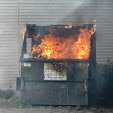
But could they have picked a slightly less ironically Orwellian location for the camera housings?
 |
| "Safe beneath the watchful eyes!" |
.
|
| "Safe beneath the watchful eyes!" |


 |
| Fuji X-T2 & XF 16-80mm f/4 R WR |
 |
| Nikon D1X & 80-400mm f/4.5-5.6D VR |


"Scott Napper, a biochemist and vaccinologist at the University of Saskatchewan, can easily envision humanity’s ultimate doomsday disease. The scourge would spread fast, but the progression of illness would be slow and subtle. With no immunity, treatments, or vaccines to halt its progress, the disease would eventually find just about every single one of us, spreading via all manner of body fluids. In time, it would kill everyone it infected. Even our food and drink would not be safe, because the infectious agent would be hardy enough to survive common disinfectants and the heat of cooking; it would be pervasive enough to infest our livestock and our crops. “Imagine if consuming a plant could cause a fatal, untreatable neurodegenerative disorder,” Napper told me. “Any food grown within North America would be potentially deadly to humans.”Well, if you want me to read your article on CWD and other prion diseases, that's certainly an effective hook of an opening paragraph, let me tell you.
This nightmare illness doesn’t yet exist. But for inspiration, Napper needs to look only at the very real contagion in his own lab: chronic wasting disease (CWD), a highly lethal, highly contagious neurodegenerative disease that is devastating North America’s deer, elk, and other cervids."

"[T]his disaffected bloc of Americans (and the poor souls living in swing states) will have to endure months on end of extreme partisan rhetoric, negative advertising, cable news vitriol, and people losing their minds on X, Facebook, Instagram, and TikTok about other people’s political views and choices—all fueled by billions of dollars in unaccountable funds from wealthy sources and activist groups that are perfectly content to see the country break in two for ideological or financial gain.
[SNIP]
The only rational form of self-protection from this madness is to refuse to engage in America’s misshapen partisan politics and to instead pursue other forms of citizenship.
Focus on something other than politics. Talk with friends and colleagues about anything other than partisan divides and culture war clickbait. Turn off and disable the media and tech sources spreading partisan negativity. Turn the mind towards something positive and constructive in life rather than imbibing party propaganda designed to make people anxious, confused, angry, or vengeful."
 |
| Kodak Easyshare at Knob Creek in 2011 |
"For sports fans of a certain age, the memory of running to the mailbox to see what was on the cover of the latest weekly issue of Sports Illustrated is indelible. For decades, the magazine’s photographers, writers and editors held the power to anoint stars and deliver the definitive account of the biggest moments in sports, often with just a single photograph and a few words on the cover. It was the most powerful real estate in sports journalism."Over time, though, it became less an exhibition of action photography and more and more of a celebrity showcase.
"“It became less of a news thing and more of a personality thing,” said Al Tielemans, a staff photographer for almost 20 years. He described an evolution of editors’ wanting the key moment of the game, and then a good photo of the star of the game, and then a photo featuring the most famous person in the game, and then finally just a headshot of a star."SI laid off all its staff photogs in 2015, and now the publication itself might be a goner.
"The internet, and social media platforms like Instagram, mean that more photography is showcased to more people than ever before. Now that fans see every angle of every game, with highlights and shots available instantly on social media, no single image has the same power that Sports Illustrated’s cover once did."Checking their online schedule, it looks like the first weekday matinee home game for the Indianapolis Indians is on Wednesday, April 17th. I guess I'll mark my calendar and get ready to go larp as a sports photojournalist...


It’s not unusual for paleontologists to disagree about ancient animal bodies — sometimes with a ferocious intensity. Gottfried recalled witnessing some scientists get into a heated disagreement over the angle of the thigh bone when assembling a triceratops specimen.The bit about shrink-wrapping the skin around the skeletons was interesting. I have a book on my Kindle shelf titled All Yesterdays that's a neat look at how illustrations of prehistoric animals have evolved over time, and also has some freaky-looking pictures of modern animals if they were reconstructed by yesterday's paleontologic illustrators from skeletal remains. You'll never look at cows... or your cat ...the same way.
John Hutchinson, a professor of evolutionary biomechanics at the Royal Veterinary College at the University of London, is part of the team that put forward the controversial 3D model of the megalodon. He said that the stakes are always high in science, but particularly when working on species that attract both public and scientific fascination.
“The more celebrity an extinct animal has, and the rarer it is, the more competitive or heated the disagreements can be,” Hutchinson said. “I know this all too well. I worked on T. rex.”
Hutchinson said that, early in his career, people used 2D illustrations of fossilized skeletons and shrink-wrapped skin around them, making them quite skinny. Based on these models, people believed Tyrannosaurus rex was around 11,000 pounds. But now, using various methods, scientists mostly agree that an adult T. rex would have been somewhere around 17,000 pounds.