Showing posts with label gun wrenching. Show all posts
Showing posts with label gun wrenching. Show all posts
Thursday, February 12, 2026
Revolver mods and what they're good for...
I wrote a piece enumerating the various modifications that one can perform to a carry revolver to make it more useful, and which ones may cause more trouble than they're worth.


Thursday, February 05, 2026
Writing Elsewhere...
- People toss "the OODA loop" (aka Boyd's Decision Cycle) around a lot, but what does it mean in the context of personal protection?
- Modifying a Mosin? Why? What do you expect the result to be?
.
Monday, December 22, 2025
Last Minute
With two-day shipping (free with Prime) there's still time for stocking stuffers.
.
- There's a cool multitool with a 1911 bushing wrench and other gun-specific tools.
- Or just a classic Victorinox SAK.
- And then there's this little manual Out-the-Front Kershaw.
- The Wedge XT from Streamlight is a popular little 500 lumen rechargeable light and it's on sale!
- If someone wants to get into a fun kind of photography, the Instax Mini from Fujifilm is a lot of fun.
.
Friday, October 31, 2025
Friday, December 13, 2024
Brace for the Arglebargle...
The laws surrounding the manufacture and sale of firearms, or even of what is and isn't a firearm in the first place, are complicated enough that event the majority of gun owners aren't familiar with even a fraction of them. (Remember that if you would list "guns" or "shooting" as one of your hobbies or interests, that alone puts you in a minority subset of people who own firearms.)


When I saw the video of the dude capping the UnitedHealthcare CEO, like Ian over at Forgotten Weapons I knew it wasn't (like idiot spokespeople at the NYPD claimed) a B&T VP9.

At the time, I remember hoping that it was at least a factory clone and not an 80% kit build or a 3D-printed frame because that would unleash a tidal wave of stupid from the sort of people who not only know nothing about guns or gun laws, but also don't like them very much.
And here we are...
At first glance, the gun in the police photographs — the one the authorities believe Luigi Mangione used to kill the chief executive of UnitedHealthcare — appears to be a Glock-19, a 9-millimeter semiautomatic pistol used by military forces, police officers, civilians and criminals all over the world.In the first sentence I'm already annoyed by the hyphen in "Glock-19" and it doesn't get much better from there.
But upon closer inspection, it is clear that the weapon was not factory-made, but was at least partially produced by a 3D printer. The giveaways are subtle: The Glock logo is absent from the pistol’s grip, where it would ordinarily be imprinted, and the angle of the grip is peculiar. Indentations on the grip, known as stippling, are patterned in such a way that the gun’s “fingerprint” can be directly linked to a unique free-to-download 3D-printed design known as the FMDA 19.2 Chairmanwon Remix.

Monday, January 22, 2024

Monday, March 06, 2023
What makes a classic?
Blogging has occurred at the other place.

Relatedly, this 27-year-old Gen2 Glock 19 has outlived its second set of night sights. Time to put some Trijicon HD XR's on it like I've been meaning to.

Friday, January 13, 2023
Unqualified Opinions
So the neckbearded influencer dude is claiming that Taurus groveled apologetically and were like "Oh, sorry! Totally our fault, man!" (Which, I mean, they may have done, if only to get him to stop pestering them. It's kind of the job of the folks who work Customer Service to calm people down.) There are even stans out white knighting for him in the comments on Instagram and elsewhere using this as proof that Beardy McBeardson Did Nothing Wrong.
I guess the Customer Service people were too polite to point out that he shouldn't have just tossed the instruction manual aside during his little unboxing video and started blasting, because if he'd read it as far as Page 22, he could have avoided beclowning himself and briefly becoming the gunternet's Main Character.
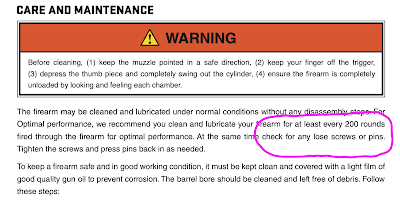
I guess the Customer Service people were too polite to point out that he shouldn't have just tossed the instruction manual aside during his little unboxing video and started blasting, because if he'd read it as far as Page 22, he could have avoided beclowning himself and briefly becoming the gunternet's Main Character.

Double action revolvers are firearms that were popular duty weapons when garages had timing lights and drug stores had tube testers. If you're going to use one heavily, you've got to know which screwdriver gets used for what and when to brush off the front of the cylinder and under the star and what a Dejammer is used for. You can't just glop more lube on every thousand rounds or so and change recoil springs after every five cases of ammo like it's a Glock.
.
Sunday, January 08, 2023
Under the Influencer
So, because of the way the publishing industry works, that column of mine that's up over at Shooting Illustrated was written months ago. Checking my email folders, it was sent in for editing in the first week of last October.
*When it comes to firearms, "catastrophic failure" has a specific technical meaning, and it doesn't mean "a screw fell out". It means "my blaster went all 'splodey".
In that column, about using revolvers for CCW today, I wrote:
"After a good range session with a revolver, cleaning it and checking it over to make sure nothing’s loosened in the screw department is much more critical than with a modern semi-auto."Note that bit about screws. That's important.
Anybody who's done a lot of revolver shooting has seen them loosen screws. The very worst I've ever seen was a Charter Arms Bulldog Pug in .44 Special I owned back in the early Nineties. I don't think I ever made it through a single range session without winding up on my hands and knees, looking for the screw that retained the cylinder release.
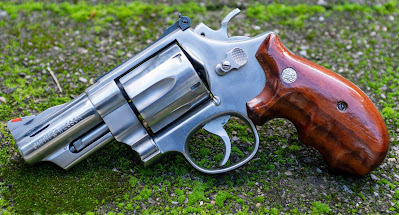
Another one that's needed more than the usual amount of attention from me has been my three inch Model 629-1. Nowhere near as bad as the Bulldog, the N-frame still requires the cylinder latch screw to be re-tightened every hundred rounds or so.

It's also one of a couple Smith revolvers I've had that were especially prone to loosening the forward-most screw on the sideplate.
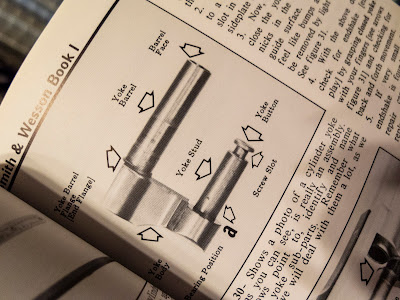
This screw is important because it not only helps secure the sideplate to the frame, but also retains the yoke in the revolver. It does this because it protrudes inside the frame and the tip rides inside a slot machined in the yoke stud, as seen in this illustration from Kuhnhausen's shop manual for the S&W revolver.
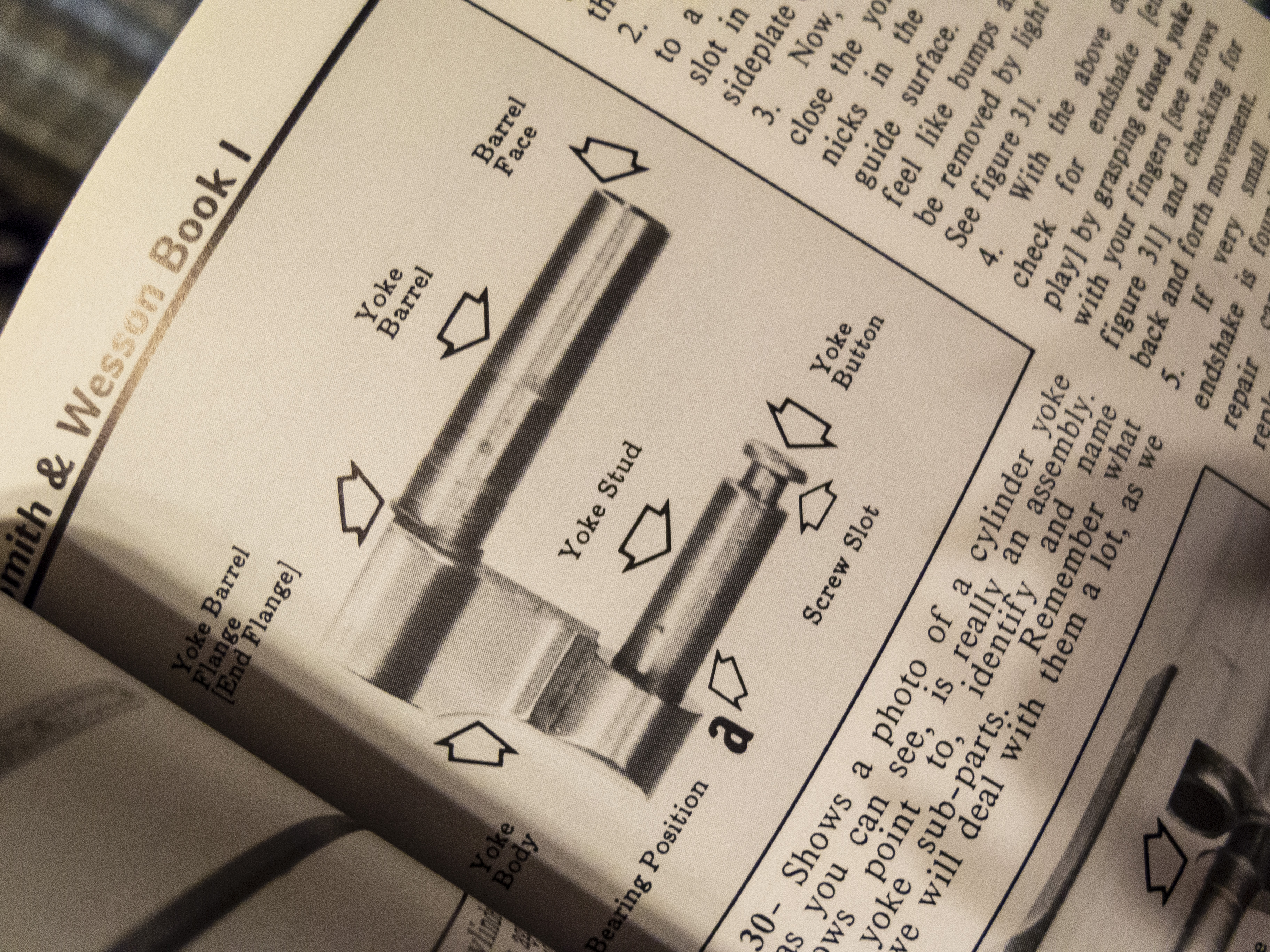
Because of this function, it needs to come out of the gun more often than the other sideplate screws.
See, there are certain maintenance or minor repair chores that do not require the sideplate to be removed (in fact, there's really no reason for the end user to need to remove the sideplate) but which are made easier by removing the cylinder & yoke assembly from the gun, which is why I'm not a fan of thread locker on this screw. Just keep an eye on it and ensure it's snug; it probably won't ever require much tightening, but it's worth being aware of.
Incidentally, the revolver will fire and function just fine even if this screw falls out.
ANYway...
All this is a roundabout way to mention that some YouTube influencer...complete with a huge beard and hundreds of thousands of followers and discount codes and everything...had the screw back out on a Taurus he was "testing" and homie absolutely lost his mind about it. He's got people in his comments calling it a "catastrophic failure"* and stuff. Wild.
I'm with Darryl Bolke on this subject: If you don't know what gunsmithing screwdrivers even look like, you might want to slow your roll on being an authority on matters revolveresque.
*When it comes to firearms, "catastrophic failure" has a specific technical meaning, and it doesn't mean "a screw fell out". It means "my blaster went all 'splodey".
.
Wednesday, December 28, 2022
Vanishing Art
In case you hadn't heard the news, Cylinder & Slide is shutting its doors for good.

In addition to being a source for great custom 1911 work and some fantastic drop-in lockwork and other parts for the classic auto, C&S was also one of the handful of places out there that was still doing first-rate revolver stuff.
Bill Laughridge hanging up his apron and selling his tools means there's now one fewer place to get a wheelgun tuned up proper, and if you want an Extreme Duty rear sight for your K/L/N-frame adjustable sight wheelyboi, better jump on it now.
Proper revolver work is going to turn into a lost art at this rate...

Saturday, July 09, 2022
It's true.

I mean, buying a full size CDP and replacing the nylon MSH with an S&A unit, gutting the lockwork in favor of some C&S drop-in bits, binning the FLGR, making sure the extractor is strac and replacing it if it's not, and putting in a Wilson Bulletproof slide stop has long been one of my "when I get around to it" projects.
Why? I dunno, I like the way they look, for one, and I also keep thinking about alloy-framed 5" 1911s. I sometimes miss that Springfield Lightweight Loaded I got from Marko years ago and then went nuts with titanium bits to make it even lighter. (It's also the only 1911 where I replaced the metal MSH with a nylon one. Gotta shave them ounces!)

Of course, those are all things I'd do to pretty much any Kimber/SA/Colt-tier pistol off the rack anyway. I look at most sub-$2k 1911s as buying a frame/slide/barrel kit.
.
Wednesday, April 20, 2022
If I'd known then what I know now...

The 296Ti, a five-shot .44Spl, was one of only two models of DAO enclosed-hammer "Centennial" L-frames made by Smith & Wesson back around the turn of the Millennium.
The other was the 242Ti, which was otherwise identical but a .38Spl seven-shooter. I bought the .44, because I was (and still am, kinda) enamored with big bore snubbies. Thing is, the gun's limited to a max bullet weight of 200 grains, lest it turn into a kinetic bullet puller under recoil. That's not such a big deal, though, since most defense-oriented loads in the caliber use 200 grain or lighter projectiles.
None of those bullets expand reliably anyway, and if they did, they'd probably wind up with marginal penetration so it's probably a good thing they don't. Take Hornady's 165gr FTX Critical Defense, for instance. In my experience it's pretty iffy in the expansion department in clear gel through four-layer denim. In bare ordnance gel, it expands just like the brochure photos...and penetrates about eight or nine inches. The same as a decent .380ACP load.

So, loaded with Silvertips or Federal 200gr LSWC-HP, you've got a bullet that penetrates about fourteen inches through 4LD with some reliability, and you've got five of them. If I'd bought the 242Ti and loaded it with 148gr Federal Gold Medal Match .38 Special wadcutters, I'd get the same amount of penetration, less recoil, and two more shots.
We live and learn.
When carried it on the belt, rarely, I carried it in an old Galco Speed Master revolver holster, which had a distressing tendency to collapse and be difficult to re-holster with. These days I'd use the more rigidly molded Combat Master from Galco... if I didn't just go ahead and get a Summer Special IWB rig from Milt Sparks.
Right after I got it, I had a gunsmith do a trigger job, trying to get the lightest possible trigger pull while still reliably busting caps. It was down around nine pounds. Of course, that required a lightened rebound spring and gave a slow reset you could easily outrun shooting fast in double action. I had that problem sorted by the late Denny Reichard of Sand Burr Gun Ranch, who set me straight with a trigger job using factory springs. Sure, it's a couple pounds heavier than it was, but it's much better for real-world use.
I should get a tritium sight on the front...
.
Thursday, April 14, 2022
The French Correction

So, set the wayback machine for the summer of 2007, when I was still living in Knoxville, right after I left Coal Creek Armory. Having some spare time on my hands, I drove over to Nashville to spend a few days at Oleg Volk's place, hanging out and providing an eclectic selection of guns for photographic purposes.
The first morning there, Oleg and a few others were heading out to go do some shooting. Having just finished a good long stretch of six-day workweeks at an indoor range, I begged off. "I'll just chill here and read, if it's all the same to you guys. If you want to shoot anything I brought, feel free to drag it along."
Among the guns they elected to take was the MAS-49/56. I handed Oleg a couple boxes of Portuguese FNM-branded full metal jacket ammunition and told him to knock himself out.
He asked where to hold on the target at a hundred yards.
"How the hell should I know?" I replied, "I've had it a couple years, but never got around to shooting it."
I spent a pleasant couple hours in silence with a book, and when the crew came trooping back in from the range, Oleg had an unhappy look on his face and was nursing his right thumb.
"What happened?"
"The rifle tried to break my hand."
Yikes. The internet wouldn't be happy with me if I broke their photographer, no matter how indirectly.
It turned out that Oleg let the bolt fly forward to chamber the first round, and the rifle promptly slamfired, kicking up a gout of dirt a few yards in front of the line and pranging the base of Oleg's thumb with that big round nylon knob on the MAS charging handle.
A bit of research on the internets turned up the fact that this is what we would call a Known Issue with some ammunition, since the MAS has a large, heavy firing pin meant to deliver a healthy lick to a hard French military primer.
The two solutions for this I uncovered at the time were to either have a 'smith lighten the factory pin, which seemed pretty iffy, or to track down one of a small number of titanium firing pins someone had allegedly made in unicorn-like quantities a few years earlier.
The importance I assigned to this task can be assessed by the fact that I finally got around to it last month...
CONTINUED AT THE OTHER BLOG...WITH PICTURES!
.
Sunday, January 16, 2022
Dumb gun myths on the internet...
Here's a guy perpetuating a particularly hoary one: "10mm 1911s will crack their frames!"
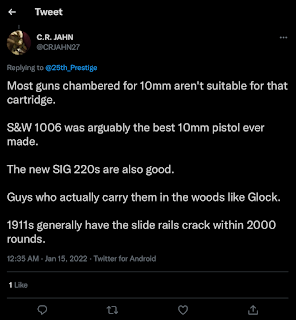
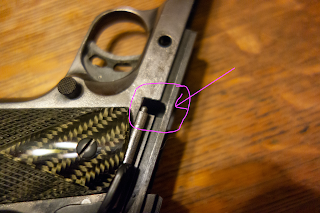
The fact that he's somewhat specific about the nature of the crack's location... I am giving him the benefit of the doubt and assuming that by "slide rails" he means "frame rails" ...and that it happens in less than 2000 rounds tells me he either recalls reading some of the initial gun magazine reporting on the Colt Delta Elite back in the Eighties, or is parroting someone who did.
Do you want to know about how and where Delta Elites actually cracked their frames? Sure you do!
Some early Delta Elites cracked their frame rails right above the rear slide stop hole, where the arrow is pointing in the picture below...
Pardon the potato-quality photo; it's not yet coffee o'clock here at Roseholme Cottage.
The crack didn't affect anything. It didn't propagate, either, since it was effectively stop-drilled by the hole beneath it.
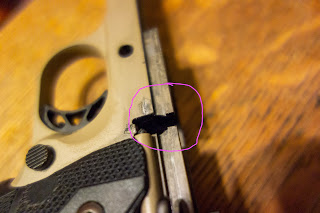
Colt solved the problem by simply removing that section of frame rail. It hasn't been there on 1911s by most any major maker for decades. In fact, I have six 1911s in my possession at the moment, five of my own and a Springfield test gun, and I had to fetch that ancient Argentine 1927 Sistema out of the attic to photograph that bit of frame rail because it's the only one that has it. (Bobbi has a couple older 1911s that do, too, but she's sleeping.)
Here's what pretty much every 1911 made in the last thirty years or so looks like in that spot...
That's a 9mm Para LTC, which was selected for the photo because the full-length guide rod may make field-stripping a pain, but it does make it easy to pop the top half off the frame and back on again in a hurry. Notice there's no frame rail at all in the area of concern anymore.
So, I screen-shotted dude's tweet instead of linking because purveyors of bad info don't need their signal boosted, plus this guy has a history of deleting stuff when called on his errors. You may remember him from his outlandish claims of preternatural prowess with the NAA Mini revolver.
Anyway, homie fancies himself quite the firearms expert. He's even written books on the topic. Instead all he does is regurgitate gun counter grade fuddlore. As the ancient Romans used to say, caveat emptor, baby.
.
Thursday, January 13, 2022
Do you suffer from projectile dysfunction?
Is your little shooter not working like it used to? Now there's a solution! Ask your gunsmith if LTT Advanced Shooter Care is right for you...
Tuesday, May 11, 2021
"Honey, we have Smith & Wesson at home." No.3
Of all the production changes made over the years to Smith revolvers to simplify production, the one I miss the most is the cylinder stop tensioner screw. That's the one you can see in profile in the frame just in front of the trigger guard. You used to just be able to stick the cylinder stop spring in through that hole, and now you have to stick it in from the side and kinda smoosh it down into its recess. I always feel like I'm going to bend it wrong when I do that.


Below is the sideplate fitment of the paltik. I've seen commercially mass-produced revolvers with sloppier sideplate fit, to be honest.

The trigger is to the rear because the trigger return spring is no longer functioning. The firearm can still be thumb-cocked and the cylinder rotates, but I haven't yet been arsed to pull the sideplate off to see what's going on in there, especially because I wouldn't fire this thing on a dare.
Incidentally, the paltik has a cylinder stop tensioner screw, too, but you can't see it in the profile shot because the head is countersunk in the hole.
.
Saturday, February 06, 2021
Custom Creations
I've done this one before, but it was fourteen years ago and the photo was potato-quality.


Basically, twenty years ago, before I'd even really gotten into collecting Smith & Wessons (the only Smif wheelyboi I owned at the time was a 625), my friend Marko and I were hanging out at Montague Gunsmithing in Knoxville, poring over the shop's copy of The Standard Catalog of Smith & Wesson. We were particularly entranced with the description of the Performance Center's rendition of the Model 13, which the Catalog described as "a very serious carry revolver".
"Oh, cool!" said Marko, "Maybe I'll find one at the gun show this weekend!"
"Yeah sure," I retorted, "and monkeys might fly out of my butt. They made four hundred of them, it says. What are the odds of one being at a gun show in Knoxville this weekend?"
Pretty good, as it turned out.

While waiting in line to get into a show a month or so later, Marko wound up swapping a .41 Magnum Ruger Blackhawk he had to the guy in front of us in line, straight up, for the dude's Model 57. In retrospect, a single-action Ruger for a pinned & recessed Smith is a pretty good trade.
Normally, a lightly-used 85-90% Model 57 would have been left to live out its life in factory condition, with a square butt and a six-inch barrel, but Marko had that PC13 on the brain and wanted to make a bigger brother for it, and thus began "Project PC57", with the skilled hands of Shannon Jennings at Montague Gunsmithing.
Step one was sourcing a new 4" .41 Magnum barrel from Smith & Wesson. This being mid-2001, it must have been one of the last ones they had in stock; only a few years later, New Old Stock parts for Smiths of this vintage just didn't exist any longer. Since the project gun had a pinned barrel, Shannon had to notch the threads on the new tube in the right place to accept the pin. Before being mounted on the gun, the barrel was sent to Mag-na-port for a quad porting job to match the one on the PC13.
Shannon ground the frame from a square-butt contour to a round-butt one, and then expertly re-cut the serrations on the backstrap so that it looked factory. The 57 originally had a target hammer and trigger. The hammer got bobbed and the wide, serrated target trigger got narrowed and had its face smoothed and rounded, and then a little strategic dabbing with cold blue restored a mottled finish to the ground areas that matched the case coloring of the untouched parts.
The gun was carefully given a fine matte blue finish to match that of the PC13. Then as a final touch, Shannon used a dovetail cutter on the front sight blade to cut a notch for a red epoxy insert in the ramp, and hand painted a white outline on the rear sight blade to match.

As it sat when I acquired it, the gun only needed two changes. First, Shannon had originally done a PPC-style trigger job on it back in '01. It was unbelievably smooth and light, but the trigger return was too soft and it was easy to outrun in fast double action work. The late Denny Reichard at Sand Burr Gun Ranch fixed it by doing a really nice street/carry trigger job, using factory springs.
Lastly, the gun has been wearing a round-to-square conversion Hogue Monogrip on it since it was built, mostly because that's all that was immediately available in the shop. I'm going to fix that as soon as I decide whether to put this slick-looking set of VZ 320s on it, or to go with Eagle Secret Service stocks to match the ones on the PC13.
.
Saturday, October 10, 2020
Range Fumbles

Imagine my chagrin when I decided to be clever by swapping out the grip module in the .357SIG conversion kit with the one from an original X-Carry...and then I get to the range and notice that the .40/.357 magazine has the floorplate with the finger-grip dinguses and the original gangsta X-module isn't relieved for them.
D'oh!
At least the ammo fairy left a forgotten box of 115gr TulAmmo in the trunk of the car, so it wasn't a complete waste of a range trip.
Speaking of TulAmmo...

That's a weird little failure to eject on the last round, with the spent case performing a backflip into the ejection port. I've had pretty good luck with rather a lot of cases of this stuff over the last few years, but in this one box I had this failure to eject and two failures to extract, one of which saw the claw pop off the case halfway out of the chamber and the other left a stuck case in the chamber that required a bit of force to be applied to the slide to get it out. I was half expecting a split case or something, but it appeared normal to the eye.
.
Thursday, September 17, 2020
Disappointing, actually...
Just as a data point, dude running a G48 with Shield Arms 15-round mags in last weekend's
Rangemaster Instructor Development class was having constant problems with them. Tom mentioned he hadn't seem them running well in a class yet, to his knowledge.
I don't mean to get off on a rant, here, but the 48 runs fine with factory 10-rounders, and Glock also makes a 4" gun that runs like a top with 15-round mags and has been more or less the industry standard for a reason.
"But have you tried...?" Hey, if I wanted to maybe have to dick around with a gun to make it run reliably, I'd buy a Kimber.
I thought the whole point of a Glock was to pull a soulless piece of combat tupperware out of the box and get to blasting with no more preparation than stuffing rounds in the magazines?
Messing around with sights or trigger shoes is one thing, adding a magwell or a Gadget or a backstrap plug doesn't affect reliability, but magazines? I have yet to run across an aftermarket Glock magazine I'd entirely trust for carry. Maybe Magpul, but only if I absolutely had to, and I'm having a hard time envisioning a scenario where I had to.
Friday, August 14, 2020
Suddenly relevant to my interests...
I wonder what the newest commercially-successful pistol design to use a self-sprung extractor is? That's a thing I hadn't really pondered. I mean, the pivoting claw has generally conquered the market, but here was Ruger holding on to the self-sprung type well into the Nineties.
.
Subscribe to:
Posts (Atom)