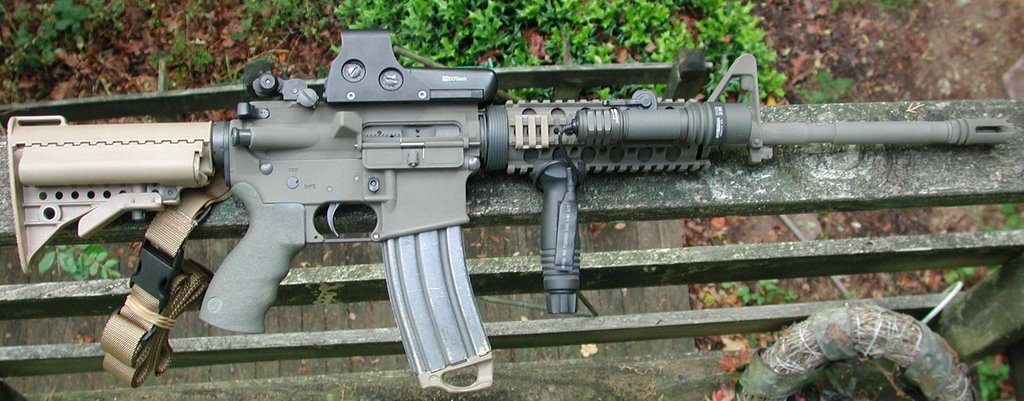
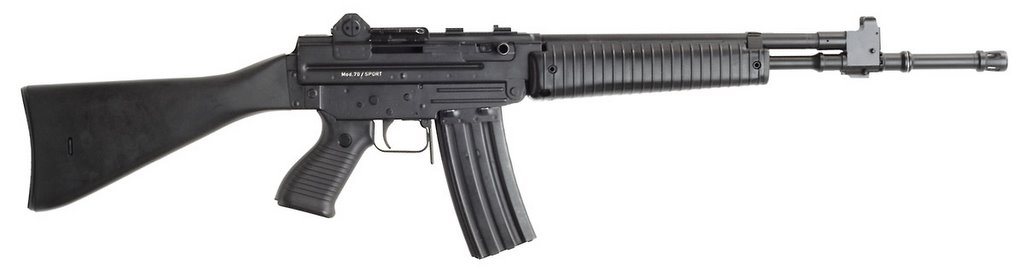
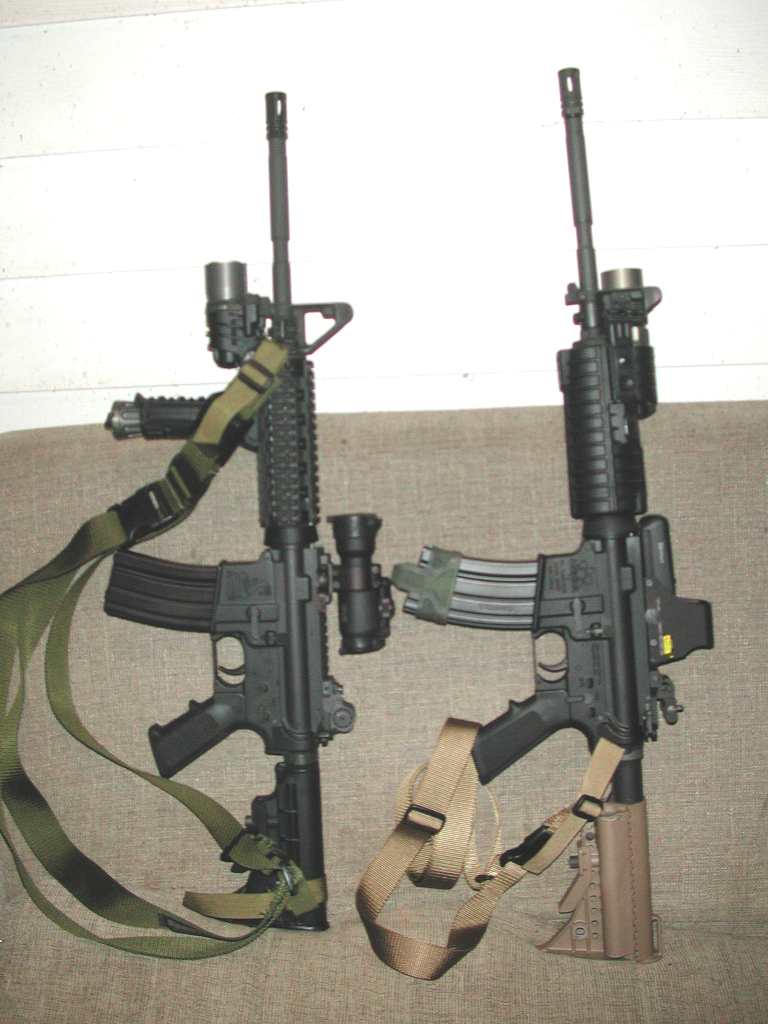
The AR-type rifle and carbine have become some of the most popular longarms in America today, and it was somewhat inevitable, given their modular nature, that they would benefit from a gigantic aftermarket industry catering to every possible whim a shooter might have for these excellent shoulder weapons. In the early days, there was a marked tendency for owners to hang every doodad and geegaw possible off of their weapons. It got bad enough that it has recently spawned a backlash (similar to the reborn Cult of the Unmodified 1911, which we'll cover in a later post) of folks who take pride in not using any accessories on their AR, and who look askance at those who do. As in most things, there's a happy medium, and I'd like to go ahead and share the lessons I've learned over the past several years; lessons currently objectified in Project Housegun.

For starters, this post is about accessories for the AR-type
in its role as a CQB-oriented carbine. There are a plethora of gizmos and gadgets available to adapt the AR to the roles of general service rifle, NRA High Power or Three Gun competition rifle, or varmint exploder extraordinaire, but those aren't what this post is about. What it
is about is the weapon that LE, the military, and increasing numbers of private citizens are using to replace the shotgun, subgun, or pistol caliber carbine as a CQB tool: the short AR carbine.
First and foremost, lets get some items out of the way that you definitely do
not need bolted to a fighting carbine:
- A magnifiying scope of greater than about 1.5 power. These are too unforgiving in eye relief and field-of-view. That, and the fact that you shouldn't need magnifiying optics on your gun if its only intended use is home defense: If you can't see it clearly with the naked eye, you're going to have a hard time explaining to the DA why you thought it needed shootin'.
- A bipod and/or free-float forend. What, you're gonna go after prairie dogs in your living room?
- A match trigger. Undoubtedly a Good Thing on rifles, they don't make enough difference on a carbine (which will be seldom fired at ranges past 15-25 yards) to offset their reduced durability.
Now on to the things that you
do want.
The biggest thing for an AR carbine isn't even hardware at all; it's software. The squared-up fighting stance, with the shooter facing squarely towards his target and keeping his elbows in like a boxer, has revolutionized the way that the shorty AR is both viewed and employed. With the carbine held high, so the toe of the stock barely contacts the shoulder, and the head held up and body squared in a fighting stance, the shooter is much more aware of his surroundings, and has an easier time moving without dismounting the weapon from his shoulder. Many of the newer accessories seen on short AR's come from this change in employment. Let's look at a couple of them.
1) Sights.
Not too many years ago, any kind of optic on a fighting rifle was heresy. With the advent of rugged red-dot zero-magnification optics, like the Aimpoint and Eotech, folks have discovered the joy of having an easy to use dot sight that is immune to eye-relief problems and virtually parallax-free. Don't waste time lining up the dot with the front sight when shooting; where the dot is, there the bullet will go. Speed is the advantage that these sights offer in spades over conventional irons, and speed is very important on a long-gun that may well be used inside Tueller Drill range. While the aforementioned two optics hold the lion's share of the market, Trijicon's Tri-Power and ACOG lines are also worth a look, as well as Leupold's CQ/T.
As far as iron sights go, if the front sight tower hanging in front of your dot sight bothers you, then by all means get a folding front sight. Better still would be to learn to ignore it while the dot is up and running, because having to flip up two back up irons (front and rear) in case of optic failure is (by definition) twice as time consuming as erecting only one, and time may not be on your side when you have to do it. For a folding backup rear, look to a quality manufacturer like ARMS, Yankee Hill, or GG&G, and make sure you get a Same-Plane aperture, so that switching back and forth between coarse and fine settings doesn't throw off your POI like it does with standard A2 sights. For the front sight post, a replacement loaded with tritium from XS Systems is invaluable. For a dedicated indoor gun, look to the dot sight post, while a carbine that may be pressed into more general service would better benefit from the vertical stripe.
2) Lights.
Unless you live by yourself in downtown Fallujah, your home is not a free-fire zone. Shooting a target without first identifying it could have a negative impact on your future social life. Given that self-defense encounters in the home tend to take place after lights-out, a white light on the weapon is a good thing. If you have the bucks to spend, a SureFire dedicated forend or M900 vertical pistol grip light is the Mack Daddy of weapon-mounted lights. For a little less money, SureFire's Millennium series or the new lights from PentagonLight will fill the bill nicely. If you're forced to light the cheap seats, Viking Tactical makes a handy bracket that will allow you to clamp a cheap SureFire 6P or G2 Nitrolon to any available Picatinny rail.
3) Miscellaneous Good Stuff.
- In the squared-up fighting stance, the non-dominant hand will be more comfortable grasping either the front of the mag well or a dedicated forward pistol grip. If you use the latter, you should probably locate it as far rearward as you can without interfering with fast mag changes. Eschew goofy gizmos like bipod/forward-pistol-grip combos on a dedicated CQB carbine.
- Some type of oversized charging handle latch will allow you to perform simple malfunction-clearing drills without dismounting the weapon from your shoulder or breaking the firing grip of your master hand. PRI's Big Latch is less likely to snag on stuff than Badger's Tac-Latch, if not quite as easy to use one-handed.
- A better grip (like those from Hogue, Tango Down, or ErgoGrip) and a gapper to fill the space in the rear of the trigger guard will make long practice sessions more bearable for your hand and trigger finger.
- A sling is to a carbine as a holster is to a pistol. You need some way to retain the weapon while your hands are busy doing other things. Three point slings are good for carbines that are intended to be carried around a lot, as they combine shooting functions with carry strap comfort, but they are bulky and have straps running every which way. A single point is better for a gun that will only be used for short periods of time; it is less encumbering, since its only purpose is to catch the gun and let it swing while your hands are otherwise occupied.
- An Vltor or Magpul stock is a zillion times better than the standard 4-position collapsable. Trust me.
Anyhow, that's some stuff I discovered while gradually circling towards replacing my house shotgun with a house carbine. A lot of it is optional, although I think the dot, light, and latch are pretty close to necessary to get the full measure out of the gun in this role. Try stuff yourself, study the available literature (the series of
Pat Rogers articles in
SWAT Magazine are a gold mine), practice, and if you dicover cool and new stuff, let me know; I'm always up for Project Housegun II.