Showing posts sorted by relevance for query Ruger American. Sort by date Show all posts

Wednesday, July 20, 2016

This Is Why We Can't Have Nice Things, Pt. I

Speaking as someone who talks about guns on the internet, it pains me to admit that one doesn't need to look long or hard to find reasons why "internet gun advice" has become the proverbial equivalent of "politician's promises" or "Confederate money" as a synonym for "valueless".

Everyone knows the guy on the forums who insists that his off-brand, low-budget pistol has been just (and I quote) "flawless" over...oh, it must be thousands and thousands of rounds, but who knows? It's not like he keeps a log book, but it's a lot!

There are the devotees of one brand or caliber or type of gun who come up with the most tortured reasons why their choice is best choice, and if you don't agree, you're just a "hater" or a "gun snob".

And on YouTube, you can't swing a 5.11 Tactical man purse without hitting some would-be instructor who doesn't know his ass from the hole he's fixin' to shoot in it.

Here's a bit of internet gun rationalizing of the second type:
Let me clear up some of his confusion: the answer comes down to ammo prices.

You can get spam cans of 7.62x54r for as low as $0.23 per round if you know where to look, whereas cheap .308 starts at $0.42 per round and .30-06 is a full $0.15/round more expensive than that.

The Ruger American Rifle comes in a bevy of calibers, but it does not come in 7.62x54R, so you can’t train as cheaply with it as you can the Mosin. If you shoot a lot, then over time the $1,000 Mosin is ultimately a lot cheaper than the $300 Ruger American Rifle.
Let's check his own math: He's claiming a $700 price difference in guns and a $0.19/rd difference in ammo costs. He says that if I shoot a lot, then the pimped Mosin pays for itself over time.

Gratuitous New England Westinghouse Mosin receiver shot
Let's cipher out the gozintas on this! *sharpens pencil* Hmmm...scribble scribble...carry the two...

At a 19¢/round gap between the two, you would need to shoot 3,684 rounds to make up a $700 cost difference.

Not that I think they don't exist, but I would like to sometime see either a Ruger American or a Mosin Nagaint with 3,500+ documented rounds in a gun book, especially the Mosin, which are often fed diets of corrosive ammo, bimetallic jacketed bullets, et cetera. That's probably most of the gun's barrel life, right there, or at least most of the accurate part of it.

The dude then suggests that Ruger make the American in 7.62x54R, which, given the diameter of the case rim, is unlikely without major alterations to the design and thus seems highly unlikely.

It's okay to like stuff just because you like it. You don't have to try and go out and justify it as the best choice for the zombie apocalypse or whatever.
.

Tuesday, December 13, 2016

New 2,000-round project...

I'd purchased a Glock 19 Gen4 for another reason some months back, but that project didn't materialize, and so I've decided to run it through a 2,000 round test for the amusement of the internet.
The brand new-pistol was field-stripped, lubricated to factory specification, and reassembled.

Fifty rounds of Winchester NATO FMJ were loaded into my two ETS magazines, while the three magazines that came with the Gen4 19 were filled with Wolf Polyformance 115gr FMJ. The remaining five rounds left in the box of Wolf were loaded into one of my other G19 mags.

As expected, all 100 rounds fired without any failures. That's 100 down and 1,900 to go.

The Ruger American Compact had spent the night locked in the trunk of my car in the unheated garage. Between the gunk of 520 rounds and whatever lube was on the gun being a little congealed, the slide was noticeably tougher to hand-cycle, and there were two light strikes on the hard military-spec primers of the Winchester ammo. There were no failures to feed, extract, or eject, however.

A size comparison between the store's rental Glock 27 subcompact, the Ruger American Compact, and the compact Glock 19. The 12-shot Ruger is similar to the M&P Compact, in that it slots between the 10-shot G26 and 15-shot G19.
.

Friday, November 18, 2016

Speed readings.

Brought both Rugers to Marion County Fish & Game yesterday to do some chrono testing. Halfway there, I realized I'd forgotten both my camera and my phone. I drove on anyway, only to arrive to the reminder that the range is closed for mowing on Thursday mornings, so I turned around and drove home to get the picture-taking equipment.

The chrono work with the Ruger American yielded some surprises. The 115gr American Eagle FMJ ammo was as slow as I'd feared:
LO: 1101
HI: 1165
AV: 1134
ES: 64.00
SD: 19.84
You start getting 115gr bullets down below 1100fps, and that seems to be the threshold at which clean ejection is a problem in a lot of pistols. This stuff probably would have been a horror show in the Canik or the Steyr, or the Ruger 9E, for that matter, at least when new.

So the PPU, with its much more dramatic muzzle blast, was much hotter, right? I would have sworn on a stack of bibles it would be...
LO: 1065
HI: 1147
AV: 1119
ES: 82.12
SD: 23.57
Color me surprised. I guess it's just slower-burning powder causing all the sturm und drang out at the end of the barrel? All twenty rounds fired functioned fine through the firearm.

For the LCP II, I brought along some 90gr Sig Sauer V-Crown JHP ammo and a box of Sellier & Bellot 92gr FMJ. The V-Crown's velocity numbers were about average for the defense ammo I've tested in this gun, being a little faster than the Gold Dots and a little slower than the Critical Defense:
LO: 806.9
HI: 896.8
AV: 849.3
ES: 89.92
SD: 33.88
Those velocities were a little more scattered than I normally expect from Sig Sauer ammo, too. I'll likely try another box from a different lot, just to see what kind of difference that makes.

The Sellier & Bellot FMJ posted the stoutest numbers I've yet seen from a .380, other than some 90gr GDHP out of the Sig P250. (And the P250 Compact's got another .75" of barrel length over the Elsie Pea Too.)
LO: 927.0
HI: 996.5
AV: 964.7
ES: 69.53
SD: 19.10
I need to get off my butt and shoot some jello. It seems like if one is of the "Carry FMJ for maximum penetration" school when it comes to mousegun calibers, then more velocity would be better velocity.

Recoil was, as they say, brisk but manageable.

I fired off the remainder of the box of S&B, for a total of sixty rounds through the LCP II that day. The pistol experienced two more failures to return to battery. (#697, #704)

It occurs to me that maybe I want to contact Ruger about the recommended recoil spring replacement intervals on these things. I mean, if this were an Officer's Model 1911, it'd be about done with its second recoil spring.

For the LCP II, this makes 736 rounds fired since the gun was last cleaned or lubricated with eight failures to return to battery (#128, #158, #245, #600, #628, #630, #697, #704) and one failure to feed (#540). 1,264 rounds to go.
.

Wednesday, January 27, 2016

If at first you don't succeed...

I think Ruger's SR striker-fired pistols are some of the best guns in the "Priced Like A Used Glock" class of pistols. The 9E, in particular, is a screaming deal.

Still, they haven't been selling like gangbusters to agencies, and agency sales are the engine that drives consumer purchases. People want to carry what the po-po does. Hence the Ruger American:

Solid-feeling and hits all the feature buzzwords with ambidextrous everything and modular grip doohickeys. I'd be interested in shooting one...
.

Friday, September 30, 2016

Fixes...

Two guns to the range yesterday, one to diagnose ammo and the other to diagnose the gun.

The P320C was to test the CCI Blazer, which had caused multiple failures to extract in the Ruger American Compact on Saturday's range trip with Shootin' Buddy. The ammo ran in the Sig, but the way rounds dribbled out of the ejection port and rolled down my forearm, or flipped weakly back just far enough to bounce off my eye pro and land in my shirt pocket, tells me that this is a weaksauce batch of CCI's budget load. They skimped on the powder and passed the savings along to the customer. Won't hold that against the Ruger.

The Glock 39 had been detail stripped and the slide flushed out with Slip2000 Cleaner/Degreaser and scrubbed of all the sticky residue, and then the striker assembly, extractor claw, and firing pin safety plunger were scrubbed with the cleaner until they were slippery to the touch instead of tacky. I reassembled it with yet a different trigger bar and took it to the range where it fired off the Magtech just fine. I think I have it pretty well de-bugged, but we'll see how it does with S&B.
.

Tuesday, November 15, 2016

Rugers in the office...

I drove over to Indy Arms Co. with a brace of Rugers yesterday morning: The LCP II and the American Compact. I had a box of Lucky Gunner's Armscor .380 for the little Ruger and some Prvi Partisan 115gr FMJ 9x19mm for the not-quite-as-little Ruger.

The Prvi had tremendous flash and muzzle blast. I still have a box from this lot and I'll try and chrono some tomorrow. The American experienced one light primer strike on its 34th round of the day (#284 through the gun). This is seemingly always a risk with striker-fired guns and harder primers, and PPU primers are harder than woodpecker lips. The round went off on the second try.

The LCP II experienced a failure-to-feed on round number fourteen of the day (#540 of the test.) Other than that, no malfunctions were experienced.

When I was photographing the target after the range session, the new guy behind the counter at IAC noticed that a pin in the Elsie Pea Too's frame had started to walk. I have tapped it flush again with a plastic hammer.

For the LCP II, this makes 576 rounds fired since the gun was last cleaned or lubricated with three failures to return to battery (#128, #158, #245) and one failure to feed (#540). 1,424 rounds to go.
.

Thursday, September 29, 2016

New Ruger pistol...

Tonight Ruger officially announced the pistol I used to shoot Dave Spaulding's Handgun Combatives "Essential Pistol" class out at FTW Ranch the other weekend: The Compact American 9mm.

Several of us ran the pistols through the class, as well as in informal range sessions and competitions before and after and, despite a rough round count between 400-700 rounds per gun (thank you, Hornady!) I only recollect two malfunctions.

You'll note the dual captive recoil spring. The gun ships with small, medium, and large backstraps, as well as both flush and pinkie-rest floorplates for the 12-rd mag and a grip adapter for the 17-rd mag. States behind enemy lines get two 10-rounders.

The guns are available both with ambi thumb safeties and in a "Pro" variant with only the trigger safety. The thumb safety locks the slide when on, like on a 1911. Kinda wish it didn't.

As you can see, the American Compact splits the difference, size-wise, between the G19 and G26, much like the Smith & Wesson M&P9C does.

The one I used at FTW Ranch was a non-thumb-safety gun, so I'm looking forward to getting more trigger time in on this thumb safety model.
.

Thursday, December 15, 2016

Gratuitous Gun Pr0n #154...

Ruger American Compact in 9mm. Test protocol calls for 5 five shot groups with three different bullet weights from three different manufacturers. I keep a bunch of odd lots of ammo on hand for just this reason.
.

Saturday, December 24, 2016

Christmas Eve Eve.

Shootin' Buddy drove down from Lafayette and we headed over to Indy Arms Co. to do some blasting.

The previous tenant of Lane 5 left evidence of their pistoleering prowess hanging out at the twenty-foot line. It's okay, dude; I'll throw your target out and sweep your brass up, too.

I'd brought two hundred rounds already loaded into magazines. The Wolf Polyformance felt a little sticky going into the new-ish Magpul 15-rounder, and you could hear rounds down in the tube ratling around, so I dumped it out and loaded them into a factory G-lock mag. The (much more well-used) 17-round Pmag with the Wolf Polyformance in it didn't rattle when shaken, and so I decided to see if it would feed...

Only the top two rounds, as it turns out. The rest of them were stuck tight by the friction of whatever coating Wolf uses on those things. Magazines I've seen Wolf Polyformance have this issue with now include both Magpul and ETS aftermarket Glock mags, as well as factory mags for the M&P9, PPX, and Ruger American Compact. They haven't yet caused this issue for me in factory Glock mags.

I'm going to put this in the notes as a "failure to feed", but since the round never actually got close to the working parts of the gun, it's hard to hold it against the pistol. This is an ammo/aftermarket mag compatibility issue. (I'll note that I've shot a reasonable amount of Brown Bear and TulAmmo through this very Magpul mag and never experienced this issue with them; only Wolf Polyformance. Go figure.)

Other than that, the two hundred rounds went by without any issues, firing fifty founds each at fifteen, ten, seven, and five yards. At each range I was trying to keep the trigger in continuous motion for 4- and 5-round strings, letting my sights be my gas pedal.

I need to do more work out past ten yards.

That makes 1,046 rounds through the Gen4 19 since it was cleaned or lubricated with one failure-to-fire (#205) and two failures-to-feed (#814, #864*). 954 rounds to go.
.

Thursday, January 06, 2011

Scout pro, Scout con.

I like slim, light, handy bolt-action rifles in reasonably potent calibers. For instance, I have two South American Mauser carbines, one from Venezuela and one from Chile, chambered in the classic 7x57mm Mauser. Both are just about an inch over three feet long and weigh in at eight pounds or less, even with the full military stock. Autoloaders in these calibers tend to be bulkier and heavier, due to recoil mechanisms and gas tubes and so forth.

Jeff Cooper spilled barrels of ink over how much he liked light, handy bolt-action rifles in reasonably potent calibers, too. I don't think he liked slim ones, though, because the one that eventually sent him royalty checks got his blessing had all the svelte grace of a gray plastic railroad tie. It was light all right, but suffered from issues with hard military primers and soft flimsy integral bipod legs.

Now comes Ruger with a little carbine built on their very Mauseresque M77 action. With a classic-looking stock that eschews geegaws like a built-in bipod in favor of being actually shaped like a rifle, it has integral backup irons, a mount for an intermediate eye-relief scope, and takes detachable magazines. This is all good.

Now the bad: Of course Ruger wanted the marketing cachet of the "Gunsite Scout©®™" name on their offering, and Shiva only knows what the per-unit licensing fee is for putting a laser-etched chicken on each gun, but I'll bet it's not free. (And if it's not, then that cost gets passed along to the consumer.) Further, when they picked their choice of detachable mags, they went with Accuracy International magazines which, like everything else from AI, are made of compressed unicorn tears and priced like imported sin. A quick look around the 'net shows them running ~$80 for a ten-round stick, and good luck finding those at Billy Bob's House of Surplus.

Tempting, but I think I'll let someone else take the depreciation hit. Besides. given the pricing in this economy, the baffling choice of mags, and the lack of cachet that the Ruger name has among tactical buffs and rifle snobs, I'd say there's a one-in-three chance that these will be available from CDNN in a year or so.

Sunday, December 11, 2016

Friday Morning Shooting...

Took a couple of test guns to Indy Arms Co. on Friday morning. One is nearing the end of its testing and the other is still in early days.

East Bloc primers are always a good test of how robust the ignition is on a striker-fired gun. The Wolf Polyformance caused some issues in the Honor Guard 9.

The Ruger American Compact went through fifty rounds of the Winchester Q4318 124gr NATO ammo without any malfunctions.

I found a tiny torx wrench to tighten the front sight on the Honor Guard 9. It held through the fifty rounds of Wolf Polyformance 115gr. Four rounds took two strikes to ignite, one took three, and one took four. All fed, extracted, and ejected properly.

Thursday, November 17, 2016

More chooting...

I intended to go to MCF&G and do some chrono work yesterday, at least I did until I saw the weatherman saying that today was going to be a good ten degrees warmer. So I decided to go shoot indoors at Indy Arms Co. instead.

In the last-minute rearrangement of my departure plans, I left my .380 ammo at home. Further, the Wolf Polyformance stuff I'd brought to shoot through the Ruger turned out to be a no-go. The coating on the steel-cased ammo didn't play well with the nickel-teflon coated mags of the American Compact, causing the rounds to stick and bind in the mag tube.

I wound up buying a couple boxes of the house ammo, Federal RTP, and soldiering on.

 The guy to my left was obviously trying to make me feel good about my shooting that day.

The American had no malfunctions of any kind. (It's at 400 rounds now, if anyone's counting.)

The Elsie Pea Too failed to go fully into battery on the second and fourth rounds and then ran fine. Incidentally, the guns had been left locked in the trunk of my car in an unheated garage overnight and were quite cold to the touch at the start of the range session. As the gunk accumulates and the lube evaporates on the LCP II, it's going to be more sensitive to stuff like that. I'm thinking that this gun is probably going to get 1,000 rounds instead of 2,000. Probably. We'll see.

For the LCP II, this makes 676 rounds fired since the gun was last cleaned or lubricated with six failures to return to battery (#128, #158, #245, #600, #628, #630) and one failure to feed (#540). 1,324 rounds to go.
.

Sunday, December 14, 2008

The Slow Death of Incrementalism and the Shift of Normalcy.

I purchased my first firearm, a Ruger 10/22, back in 1986 from a sporting goods store in a mall. I handed over my money, filled out a yellow form (back then, everything fit on the front), showed them my driver's license, and walked out with my purchase. There was no background check. The manager did not carry my rifle and ammunition to the exit; to the contrary, I ate lunch in the food court with a big white box that said "RUGER" in my lap and the bag containing my Ram-Line folding stock and 25-rd magazines next to my chair.

Shooters who didn't get into the whole "gun thing" before the early '90s will find this a bit shocking. No background check? Carrying a "pre-ban" weapon and magazines through a mall? Hey, the past is another country; they did things differently there. I mean, the mall in question had ashtrays.

By the same token, shooters of the generation before me will have wistful observations of their own. After all, they probably didn't have to fill out any forms when they bought their first gun. They may have even ordered it through the mail. From Sears.

People tend to accept as status quo whatever they're used to. A generation of American kids has grown up walking through metal detectors at school, their clear or mesh backpacks scrutinized for butter knives or aspirin bottles, whereas I remember the occasional deer rifle in the back window of a pickup truck in the senior lot. (There's another vanished icon in much of America; an unsecured rifle in an unlocked truck...)

What are gun owners now coming of age in California or Massachusetts going to consider "normal" and "reasonable" restrictions?

Sunday, July 19, 2020

A Different Flavor of Panic

The firearms industry is currently in the throes of a second wave of panic buying. The first was kicked off by the early days of the 'Rona, when people decided that an extra AR15 and a case or three of ammo was necessary to defend their stash of hand sanitizer and toilet paper.

The second wave was kicked off during the protests and riots following the killing of George Floyd. It still seems to be going strong and at this point it's highly unlikely that supplies will return to anything like normal before it's time for the Great American Quadrennial Election Year Gun-Buying Freakout.

This current panic has a different flavor to it than most, though. Available evidence shows that there are a large number of first-time buyers looking for something to defend home and hearth, rather than existing gun hobbyists adding a twelfth or thirteenth AR15 to an existing collection.

Exhibit A would be that, while budget AR15's have disappeared from dealer shelves, there's no real shortage of lowers, lower receiver parts kits, or completed uppers at most of the vendors I've checked. You may not be able to buy a Ruger AR-556 or Smith M&P15 at your local gun store right now, but you can go to Palmetto State Armory or CDNN and buy the parts to build all the ARs you want.

That was not the case during the '08 or '13 panics, where stripped lowers were rationed and you couldn't find a LRPK or BCG for love nor money.

What this tells me is that the current wave of buyers is not largely made up of hobbyists fearing bans, but non-gun-owners wanting to buy a firearm for home defense. Those people don't know about buying a Poverty Pony lower from CDNN and a blem upper from PSA and rolling their own; they just know about going to the gun store and buying a gun.

The other signal is that the quintessential American Normie Home Defense Long Gun, the 12 gauge pump action, is selling like hotcakes and sometimes at crazy prices...


If you're looking at those prices and thinking "Hey, I've got that old Fuddblaster 28" Wingmaster I bought when I thought I might take up bird hunting. I should put a shorter barrel on that thing and Gunbroker it!" then I've got bad news for you, because it looks like you weren't the only person with that idea...


This reminds me that I need to change the batteries in the light on my own 870...
.

Sunday, November 02, 2008

.405 Winchester vs. .45-70 Government

This was an interesting question that popped up in search terms, and I thought it was worth discussion.

The .405 Winchester is a pretty serious big game cartridge, intended for Winchester's Model 1895 lever-action rifle. Designed from the ground up as a smokeless powder round, it is just short of being considered a real dangerous game cartridge by virtue of the fact that all commercial loadings for it use a 300-grain .412" bullet, which is a little lacking in weight and sectional density for stopping the charge of the largest African game (although T.R. laid out lion with the round...) It should be more than adequate for anything that walks, crawls, or flies on the North American continent, although I wonder why a caliber deemed insufficient for dispatching dangerous game in Africa is considered okey-dokey for the minivan-with-fangs that is the Alaskan brown bear...

The .45-70 is hampered by the fact that the first rifle chambered for the loading was the Trapdoor Springfield. As a result, anything you buy from the Big Three (Remington, Winchester, and Federal) is going to be throttled back so as not to turn Paw-paw's floptop into a pipe bomb. The stuff I keep around the house as fodder for my M1873 Springfield offers a 300gr unjacketed bullet meandering out the muzzle at something less than 1400fps, for less muzzle energy than today's most adventurous handgun loadings. In a modern rifle, such as a Marlin 1895, however, truly vigorous ammunition from Buffalo Bore is available, and in a Ruger No.1, you are free to handload items that will kill on one end and maim on the other.

If you have to pick just one of the two to sledge down really big critters, I'd go for the .45-70 and a modern rifle, to take advantage of the really scary stuff available from the boutique ammo companies.

You get a lot more style points for a .405 Winchester, though...

Thursday, May 08, 2008

Lock Mess Monster.

The issue of the internal lock that S&W added to their revolvers is one that has generated far more heat than light on the internet over the last several years. Initial resistance was mostly split along two lines: The first was aesthetic; the new lock appeared as an ugly little metal zit on the side of the gun just above the cylinder release, complete with an inscribed "L"-and-arrow indicating which direction to turn it to disable the gun, and a Rube Golberg-esque flag that popped up to indicate that the gun was locked. The second was philosophical; people refused to buy a gun that had a feature that was such an obvious nod to the anti-gun crowd and could render a sidearm inert at a time when it was needed most.

The issue was complicated when, after a year or so, rumors began to trickle down about revolvers that had spontaneously locked themselves when firing. Several prominent gun writers pooh-poohed these claims in print, predictably resulting in incendiary internet diatribes about "paid shills of the gun industry". The argument has smoldered fitfully along ever since.

Recently a thread on ARFcom, complete with pictures, concerning yet another spontaneously-locked revolver has triggered yet another flareup of "See? I told you so!" on the web, including posts from people on Evil Black Rifle gun boards who are no more likely to carry a S&W revolver than they are to sprout wings and fly.

As usual, the truth about the matter lies somewhere in the middle, and I'd like to offer a couple of thoughts on the matter. Remember, I'm just someone who worked in the retail firearms sales and repair industry from 1993 to 2007 and who has owned probably close to a hundred S&W revolvers, including three with the dreaded internal lock. My opinions are no more valid than anyone else with a keyboard and an internet connection:

1: Locks are not some demonic S&W invention. Springfield, Bersa, H&K, Glock, Taurus, Ruger, and S&W all have locks on some or all of their handgun lines. These locks are all done with varying degrees of mechanical aptitude and aesthetic obtrusiveness. Barring a significant change in the American political and legal climate, locks on handguns are with us to stay. A ban on handguns is more realistically likely than the disappearance of integral locks. Deal with it.

2: S&W are not the only locks that have failed. Over the years I have seen one failed S&W lock with my own eyes. I have also seen one Bersa, one HK USP9F, and a double handful of Tauruses that have suffered some manner of lock-related failure that rendered the gun inoperable.

3: Verifiable S&W lock failures seem confined to a narrow class of firearms. Almost to an incident, they seem to occur on flyweight Titanium/Scandium magnum revolvers shooting magnum loads. The recoil impulse on these guns is so savage that bullets are pulled from their crimps sometimes. It is therefore unsurprising to me that the gun could rotate under recoil briskly enough to leave the lock parts hanging in place under their own inertia, locking the weapon. This is a serious design flaw with the S&W lock and one that they should rectify, especially before some gnawed hiker corpse is found in bear country with his two-ounce riboflavin-framed .44 Magnum in his hand, locked up like Fort Knox.

If you absolutely must have a helium revolver chambered for he-man magnum loads, instructions are available on the big Smith & Wesson fan forum for disabling the lock by grinding off one little metal stud with your handy-dandy Dremel Tool, invaluable sidekick of shadetree gunsmiths everywhere.

From anecdotal evidence I have gathered, another component of these lock failures is that the locks on the subject weapons have all been used (or, in industry parlance, "fiddled with"). One reason I think that this is a component, if not a necessary prerequisite, is that the lock parts are manufactured via the MIM (metal injection molding) process, which is not known for turning out glass-smooth surfaces from the factory. Out of the box, this results in locks that have enough stiction that they are difficult to apply on purpose, let alone by accident. Were someone to take their new flyweight bear gun out and fiddle the lock back and forth to watch the little flag pop up and down, they would notice its application become a mite easier as the rough mating surfaces were bedded together by the repeated application of the key. One may rest assured that neither of the two lock-equipped revolvers I own has ever had the lock turned.

"What?" you say, "You own Smiths with locks?" Yes, I do, although I cordially dislike the little bugger on mostly aesthetic grounds. The two Smiths I own with locks are models that I wanted that had no pre-lock equivalents, so it was deal with the lock or deal without the gun. One is a steel-cylindered AirWeight .32 Magnum that is my everyday backup CCW gun, and the other is an all-steel large-frame .44 Special. Neither generates enough recoil impulse to make me worry about the lock at all. Incidentally, I also used to own a Titanium-cylinder .45 ACP revolver with the lock. The gun generated enough recoil to cause lightly-crimped ball ammo to jump its crimp, but in the thousand or so rounds I put through it before I traded it, it never had an issue with the lock. Again, I just don't think it had the Wheaties, recoil-wise.

One other reason I just can't get my dander up about this issue the way others have is that when an end user looks at those pictures on ARFcom, they see "OMG! A S&W LOCK FAILURE!!!1!!". I look at them and see "Ho hum. Another broken gun." Having worked in places with 'We Fix Busted Guns' signs out front for so long, I have seen so many firearms that have broken in so many ways that a new one fails to engage (pardon the pun) my interest. Frankly, if I had an AirLite .44 Magnum, I'd be as, or more, worried about the riboflavin cylinder failing or the little sheet metal tab in the topstrap getting eroded away and the frame getting flame-cut to uselessness as I would about the lock getting inadvertently activated.

A final grace note: I have to wonder how many people on those threads have shaken their heads at the sight of the jammed-up .41 Magnum S&W and pompously stated "Look at that! I'd never carry such an unreliable gun for self defense. Damn Smith & Wesson!" and then walked out their front door after stuffing their holster full of a semiautomatic pistol on which they have never performed One. Single. Malfunction. Clearance. Drill.

Idiots.

Sunday, December 29, 2019

Ten Years Ago at VFTP...

From December 2009...
"So the cover of this month's American Rifleman announces "The Unexpected SIG516". 
A new AR clone these days is about as "unexpected" as another Friday the 13th sequel or Law & Order spinoff. What's "unexpected" is that there are still some gun manufacturers who haven't jumped on this bandwagon, since all that's needed to get in the game is an ATF variance letter sent to Continental Machine Tool or Sabre Defense. In a world where such unlikely candidates as Ruger, Remington, and Smith & Wesson are pimping AR-style carbines, what's left? 
Here are my predictions for "unexpected" AR announcements at SHOT: 
  1. Harrington & Richardson H&R-15: Cast parts and stained birch furniture keep costs down. Sold at Wal-Mart for $109.95.
  2. Marlin MAR-15: Neither direct impingement nor piston operated, the MAR-15 is California-legal, since the bolt is cycled via a complex linkage actuated by rocking the pistol grip forward and back.
  3. Thompson/Center EncoR-15: Available in almost two hundred chamberings, three quarters of which are designed by J.D. Jones and only of interest to handloaders who also hunt rabid grizzly bears.
  4. General Motors GI-15: Unsold inventory stocks will allow these to be sold at zero percent financing with a hefty manufacturer's rebate less than six months after their introduction. Brace for recalls.
  5. Apple iR-15: Only works with proprietary ammunition. Made of sleek, white plastic. Has to be sent to an authorized service center for field-stripping and cleaning. Owners soon sport glazed, zombielike expressions of loyalty familiar to posters at MacForums or GlockTalk.
  6. Harley-Davidson HD-15: Leaks oil. Comes with clip-on ponytail and lick'n'stick eagle tattoo in box, as well as coupon for chromed BUIS, charging handle, and highway pegs."

Wednesday, December 23, 2009

Unexpected?

So the cover of this month's American Rifleman announces "The Unexpected SIG516".

A new AR clone these days is about as "unexpected" as another Friday the 13th sequel or Law & Order spinoff. What's "unexpected" is that there are still some gun manufacturers who haven't jumped on this bandwagon, since all that's needed to get in the game is an ATF variance letter sent to Consolidated Continental [ed: D'oh!] Machine Tool or Sabre Defense. In a world where such unlikely candidates as Ruger, Remington, and Smith & Wesson are pimping AR-style carbines, what's left?

Here are my predictions for "unexpected" AR announcements at SHOT:
  1. Harrington & Richardson H&R-15: Cast parts and stained birch furniture keep costs down. Sold at Wal-Mart for $109.95.
  2. Marlin MAR-15: Neither direct impingement nor piston operated, the MAR-15 is California-legal, since the bolt is cycled via a complex linkage actuated by rocking the pistol grip forward and back.
  3. Thompson/Center EncoR-15: Available in almost two hundred chamberings, three quarters of which are designed by J.D. Jones and only of interest to handloaders who also hunt rabid grizzly bears.
  4. General Motors GI-15: Unsold inventory stocks will allow these to be sold at zero percent financing with a hefty manufacturer's rebate less than six months after their introduction. Brace for recalls.
  5. Apple iR-15: Only works with proprietary ammunition. Made of sleek, white plastic. Has to be sent to an authorized service center for field-stripping and cleaning. Owners soon sport glazed, zombielike expressions of loyalty familiar to posters at MacForums or GlockTalk.
  6. Harley-Davidson HD-15: Leaks oil. Comes with clip-on ponytail and lick'n'stick eagle tattoo in box, as well as coupon for chromed BUIS, charging handle, and highway pegs.

Wednesday, September 27, 2006

From the Vault: Revolutionary rotary...

Germany had barely begun issuing the new Gewehr 88 to its troops when it found itself dragged into a courtroom by Osterreichische Waffenfabrik-Gesellschaft, better known here as Steyr. The Austrians took issue with the fact that the German Rifle Testing Commission had more or less pirated the clip loading system invented by Steyr's star designer, Ferdinand von Mannlicher. The resulting settlement allowed Steyr to manufacture Gew.88's for the German army, as well as for foreign sales.

By this time, Mannlicher had a new protege, and Steyr a rising star, in the form of a fortysomething engineer by the name of Otto Schoenauer. He set about making various refinements to the Gew.88 and, when the older rifle began losing ground to Paul Mauser's newer charger-loaded designs, fitted his modified version of the Commission Rifle with a slick new development: A rotary magazine. This magazine had a rotating spindle in it, notched to hold the bullets, and would feed cartidges very smoothly, as it minimized the friction of the cartridges rubbing against one another in the magazine, unlike the staggered box designs common on other rifles of the day. Packaging his new magazine in his latest upgraded rifle, he began shopping it around Europe.


Above: Greek M1903/14 Mannlicher-Schoenauer, Photo by Oleg Volk

The rotary magazine could be charged with a stripper clip like a Mauser, but could be safely unloaded through the ejection port with the press of a button unlike Mauser designs, which needed the magazine floorplate to be hinged down or removed for safe unloading. The rifle itself was slim and graceful, weighing in at only 8.25 pounds even in the full 48" long infantry version.


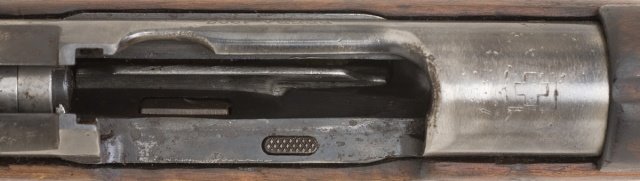
Left: The rotary magazine, viewed from above. The button on the right-hand receiver wall releases the magazine's contents. Photo by Oleg Volk.


The action was ultra-slick, with a full-length guide rib, and had several safety and reliability tweaks over the Commission rifle, but this didn't help sales. Fearing complications caused by the slightly Rube Goldberg-esque magazine, armies stayed away from the new design in droves, and Schoenauer's baby was flattened by the Mauser juggernaut on the world market.

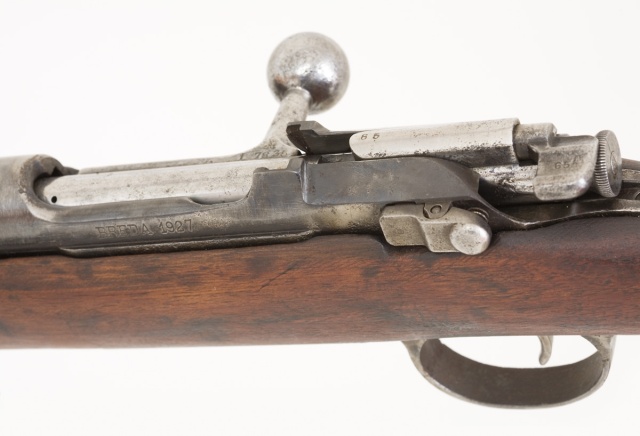
In the end, the only nation that bought the rifle was Greece, who, in a bizarre twist of fate, found themselves on the wrong side of the trenches from their main rifle supplier when World War One broke out. By the end of that conflict, Greece was badly short on Mannlicher-Schoenauers, and was making up their losses with captured Austro-Hungarian Steyr-Mannlichers and hand-me-downs from their allies. After the war they needed more rifles, but Steyr was located in the new nation of Austria and, as part of the losing side, couldn't sell military arms on the world market under the terms of the Treaty of Versailles. Relief was to be had in 1926 when Breda, in Italy, was contracted to supply M/S 1903/14 rifles and carbines. The Greeks eventually phased the rifle out of frontline service, replacing it with Mausers, and later, as a part of NATO, with British and American arms. Rumor has it, incidentally, that the Breda contract rifles were actually merely assembled and marked there, and had actually been manufactured at Steyr.


Right: Gew.88-derived action. Used in Greece. Marked in Italy. Made in Austria? Photo by Oleg Volk.


So as a military rifle the Mannlicher-Schoenauer was a flop, but its smoothness made it a very popular sporting rifle. It was successfully marketed and sold as such from 1903 into the 1950's, pretty much unchanged. One reason that original military models are so scarce on the collector's scene today is that most all of them were turned into sporters after they appeared on the surplus market.

Oh, and about that fragile rotary magazine that militaries of the day didn't like? Maybe it's not so bad; it hasn't stopped Ruger from selling a blue million 10/22's...